


One of the most exquisite presents given to a child is to help him develop a heart-related relationship with the Quran. It is not imposing the memorization or to aim at perfection. It is about teaching, loving and making the Quran feel cozy, purposeful and alive in the daily practices. This paper presents pragmatic, soothing and research accessible methods parents can use to motivate children to study the Quran: in a natural, respectful and effective manner.
Why This Matters
The ability to read is not alone since early exposure to the Quran creates a worldview. It has an influence of personality, sympathy, and meaning of life to a child. As soon as learning is a form of loving habit, but not a task, children experience more chances of revisiting the Book over the course of their lives. Parents who are leading with patience and kindness provide the children both with spiritual strength and with emotional protection.
Establish a Climate: Establish a Compassionate Education Atmosphere
It depends on the initial impressions of a child. Create a conducive atmosphere when studying Quran.
- Select a small spot, with low lighting, and seats that are comfortable.
- Always make them brief, particularly with younger children 10–15 minutes can do.
- Take the pressure off: there is not one comparison, not one humiliation in public, no lists of errors.
- Use soft expressions of praise: I love how you just read that verse, and not just clap either.
A few atmospheric adjustments will make the Quran learning feel more like a family practice as opposed to a test.
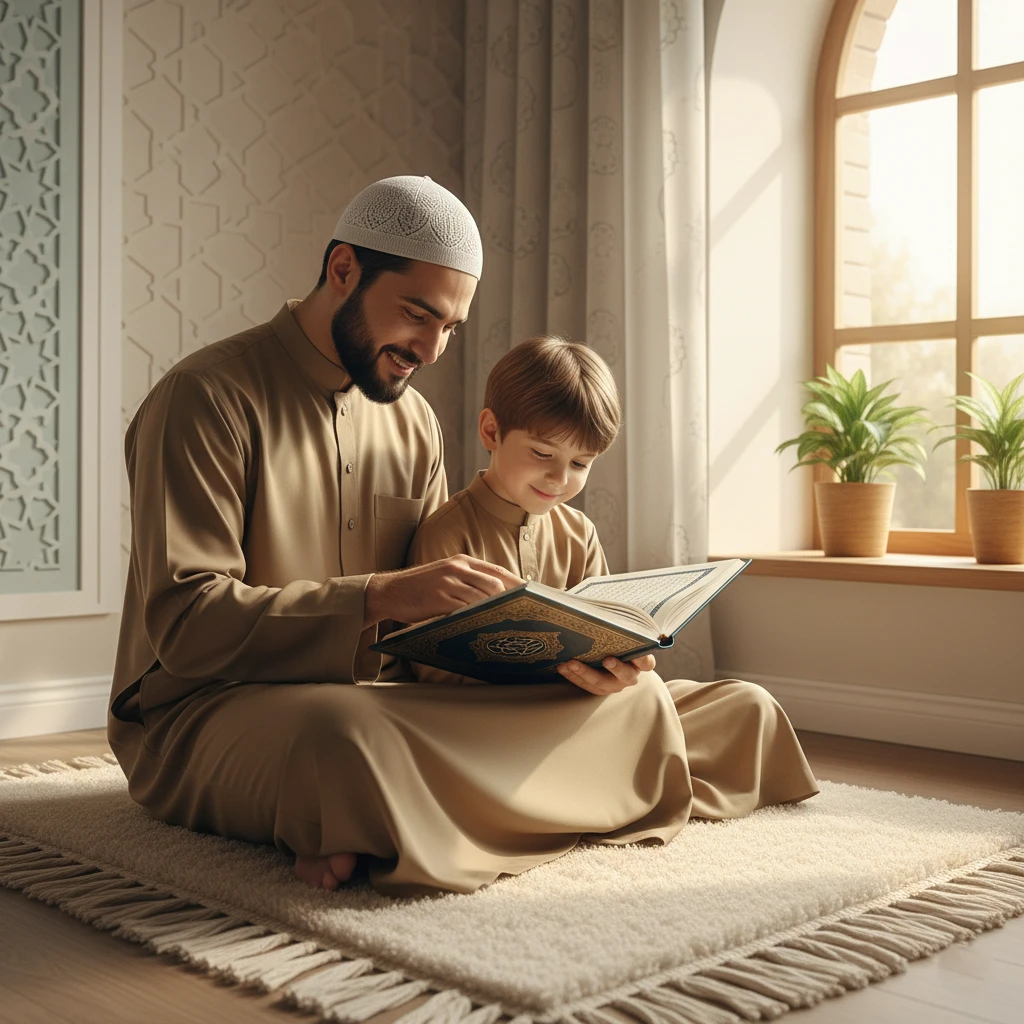
Make Learning Meaningful, Not Mechanical
Children relate when they are made aware of the reason behind something.
- Give the simple definition of short verses using simple words that children can identify with.
- Take stories out of the Quran as examples on moral lessons to use – make them old-fashioned and brief.
- Connect the lesson to everyday life: thankfulness after eating your meal, beneficence towards your siblings, honesty during play.
- Promote inquiring and interest. When you do not know something, then you should model what it is like to learn with one another.
Children learn not only minds but also heart when they observe what is taught in the Quran.
Routine Living That Establishes Regularity
Consistency makes the children develop habits without being pressured.
- Create a daily routine: a morning recitation, before going to bed dua, or reading together with the family after dinner.
- Have a conspicuous, yet not complicated tracking system or chart stuff that rewards effort, as opposed to perfection.
- Be realistic and consistent: a line a week or three little verses a day.
- Congratulate achievements with positive words, family dua, or some non-material prize, such as additional story reading time.
This is because routines must be natural. When a schedule breaks into a war, relax and streamline.
Apply Age-Specific and Interesting Techniques
Various ages require varying treatment. Correspond to the stage of the child.
Toddlers and Preschoolers
- Memory is assisted by short chants, songs, and rhythmical recitation.
- Use colourful story books with short stories of Quran.
- Make learning to be multisensory: touch, listen, repeat.
Early School Age
- Simple tajweed rules must be introduced gradually.
- Short surahs and short meanings Use flashcards.
- Promote reading out loud with slight correction.
Older Children and Teens
- Talk about further definitions, setting, use.
- Ask them to take a short family recitation or give reflections.
- Offer resources and qualified teachers to structured learning of the appropriate age.
Adjust methods when needed. Flexibility keeps learning joyful.

Be the Model Your Child Can Mirror
Children learn more by watching than by hearing advice.
- Let them see you recite, reflect, and respect the Quran.
- Share what a verse means to you in simple words.
- Show calmness and humility; admit when you are still learning.
- Make family moments around the Quran genuine and unscripted.
Modeling shows children that a relationship with the Quran is a lifelong journey.
Choose Respectful Teaching Support
An effective teacher is noteworthy. Find professional teachers with familiarity on children and development of character.
- Seek tutors that correct in low-key manner and reward.
- Choose teachers who can offer sense and induce thought rather than the rote learning.
- When applying online program, review teacher and trial lessons on first check.
- Stay involved – ask for regular progress notes and suggested home practice.
A supportive teacher paired with loving home guidance creates a powerful learning circle.
Make Learning Joyful and Creative
Learning becomes part of life when it’s also fun.
- Use short animated stories, calligraphy exercises, or simple crafts tied to verses.
- Create family recitation circles where each member shares a short verse.
- Introduce age-appropriate apps or audio recitations for variety – always vet content first.
- Turn revision into a gentle game: matching verses to meanings, or telling “what does this verse ask us to do?”
Joy sustains effort. When children enjoy learning, they return willingly.
Encourage with Dua and Emotional Support
Spiritual and emotional encouragement go together.
- Pray for ease and understanding, and teach children short duas related to learning.
- Accept their emotions: it is natural to feel exhausted, distracted or angry.
- Apply positive words: Small steps each day – that is how strong habits can be built.
- Be open and pleasant in communication, your encouragement is more important than you believe.
Dua, love, and reassurance make children relate learning with parenting.
The Pitfalls and Their Common Pitfalls
- Excessive attention given to speed: concentrate on gradual improvement.
- Punitive measures: avoid punishment linked to Quran mistakes.
- Perfection pressure: celebrate sincerity and effort.
- One-size-fits-all methods: adapt to each child’s learning rhythm.
When in doubt, choose compassion over correction.
Short Practical Checklist for Parents
- Create a calm, dedicated learning corner.
- Keep sessions brief and consistent.
- Explain meanings in simple, daily-language examples.
- Praise effort, not just results.
- Model recitation and reflection.
- Select caring, child-friendly teachers.
- Use stories, crafts, and gentle games to reinforce learning.
- Make dua and offer emotional support.
Conclusion
Getting kids to study the Quran is an experience that is guided by patience, customary routines, and the manner of loving example. It is not the quickness with which a child can memorize but rather their being ushered in an amicable manner. When the parents give importance to meaning, safety, and happiness the children are much more likely to develop a life long love of the Quran. Get small steps started slowly.. The rest will follow from care, prayer, and steady encouragement.